Condition A
Three shingles were damaged in one localized area by wind while the surrounding roof remains serviceable. That may still be a repair situation.

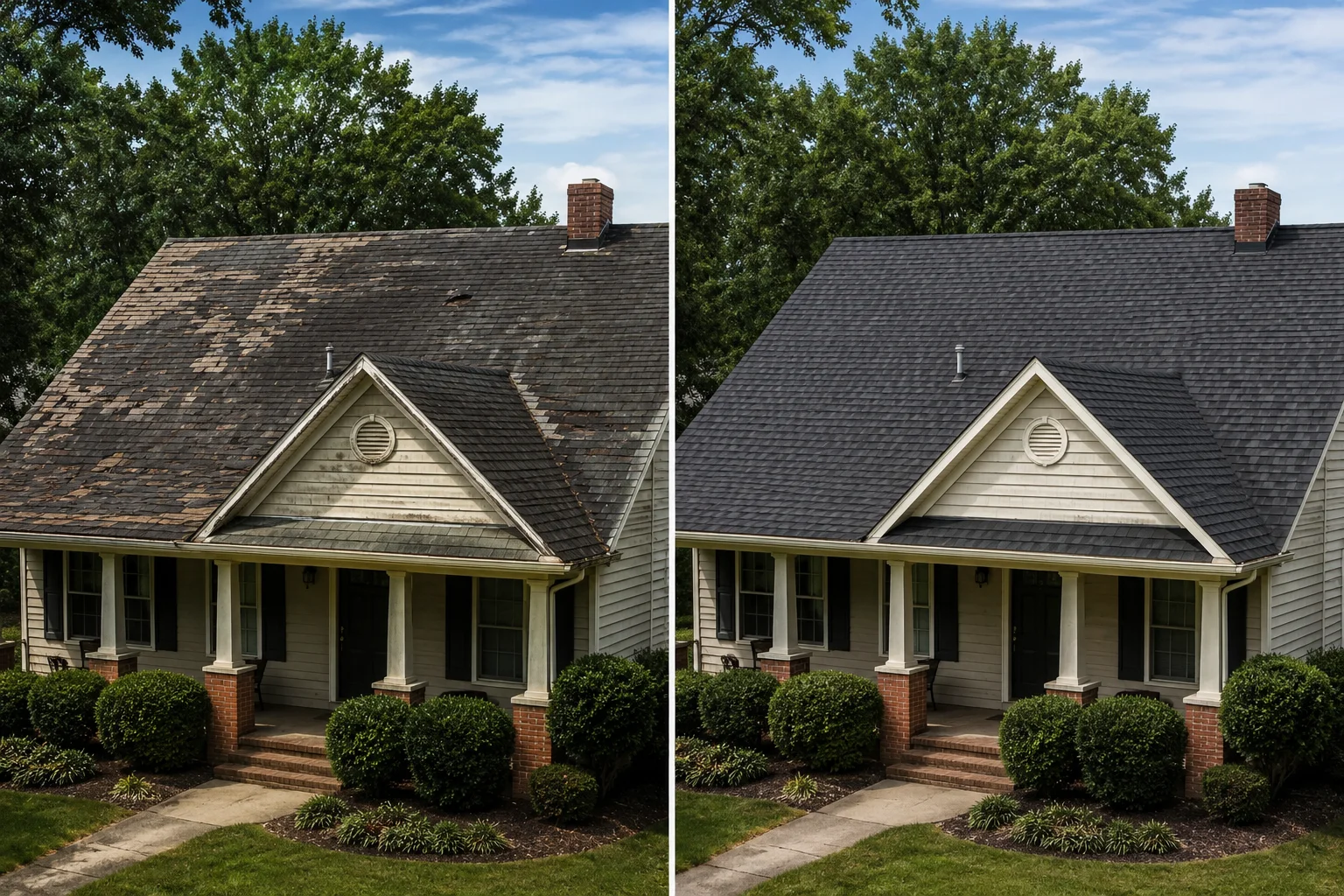
The strongest signs you may need a new roof are not simply that the roof is old or that one shingle is missing.
But one warning sign does not automatically equal a new roof.
A single damaged shingle, one failed pipe boot or one localized flashing problem may still be a repair.
The important distinction is: isolated defect → may be repairable. Widespread or recurring deterioration → replacement becomes more likely.
| What you notice | What it may indicate | Replacement signal |
|---|---|---|
| One or two damaged shingles | Localized damage | Low by itself |
| Curling or cracking across many areas | Broad shingle deterioration | High |
| A few granules in gutters | Can occur normally | Low by itself |
| Bare shingle patches / heavy granule loss | Loss of protective shingle surface | Moderate to high |
| One isolated leak | Local flashing, shingle or penetration failure may be possible | Low to moderate |
| Repeated leaks in different locations | Multiple parts of the roof may be deteriorating | High |
| Several previous repairs across the roof | Roof may be entering a recurring-failure cycle | Moderate to high |
| Sagging or visible roofline deformation | Possible decking or structural concern | Urgent evaluation |
| One flashing failure | Often potentially repairable | Low by itself |
| Multiple deteriorated roof details plus worn shingles | Broader system condition | High |
| Old roof with few other symptoms | Age is context | Inspection needed |
| Old roof plus several deterioration signs | Age and condition now reinforce each other | High |
This is the key idea for the entire page: Replacement should follow the condition of the roof as a whole, not one symptom taken out of context.
A few damaged shingles after wind or impact do not necessarily mean the roof needs replacement.
The concern changes when similar deterioration appears across substantial areas of the roof. Look from the ground for shingles that appear curled at the edges, cracked, broken, visibly deteriorated, missing across several areas, or uneven and no longer lying normally.
Three shingles were damaged in one localized area by wind while the surrounding roof remains serviceable. That may still be a repair situation.
Curling, cracking and deterioration appear on several roof planes, and additional shingles are becoming difficult to work around without causing more damage. That is a much stronger replacement signal.
The visible defect matters. The condition of the roofing around the defect matters just as much.
Asphalt shingles have mineral granules on their surface.
Seeing some loose granules does not automatically mean the roof is failing. Some granule loss is normal, while excessive loss—particularly where bare areas become visible—can indicate aging or deterioration.
What deserves closer attention is unusually heavy granule accumulation, obvious bare spots on shingles, large areas that have lost surface texture, or granule loss occurring alongside cracking, curling or other deterioration.
Don’t Diagnose the Entire Roof From the Gutter
Granules in a downspout are one clue. They do not tell you which roof plane they came from, how extensive the loss is, whether the remaining shingles are still serviceable, or whether another roofing condition is present.
The roof surface and overall deterioration pattern still need to be considered.
One leak does not automatically mean you need a new roof.
A localized leak may come from one flashing detail, a pipe boot, a penetration, several damaged shingles, or a small transition problem.
That is very different from a roof where one area is repaired and another unrelated area begins leaking months later. Then another. Then another.
Repeated Leaks Change the Question
After multiple failures, stop asking only “Can this new leak be repaired?”
Also ask: “Why are separate parts of this roof continuing to fail?”
Repeated leaks can indicate that individual repairs are becoming symptoms of a broader roof condition.
That doesn’t prove replacement by itself. It makes the history of the entire roof increasingly important.
A roofline should not develop an obvious dip or sag.
Sagging deserves prompt professional evaluation because the visible roofing material may not be the main issue.
The concern may involve roof decking, moisture-damaged sheathing, framing, or another structural condition.
Sagging Is Not a “Wait Until Next Season” Sign
Do not climb onto a visibly sagging area to investigate it.
A deformed roofline requires determining what is happening below the finished roof covering.
Sagging means evaluate promptly. It does not mean guess at the solution from the driveway.
Ceiling stains and attic moisture tell you water or moisture is somewhere it should not be.
They do not automatically tell you that the entire roof needs replacement.
Attic leaks, ceiling water damage and sheathing decay are roof-damage indicators that deserve investigation.
A single stain may still trace back to one correctable exterior detail.
Replacement becomes more plausible when moisture evidence appears alongside other conditions such as repeated leaks, deterioration in several areas, widespread shingle wear, damaged decking, or previous unsuccessful repairs.
Interior Damage Can Look Worse Than the Exterior Defect
Water may travel along decking or framing before appearing inside. That means the largest ceiling stain does not necessarily sit beneath the largest roof defect.
Do not judge the replacement decision from interior appearance alone. Follow the evidence back to the roofing condition.
A repaired roof is not automatically a bad roof.
Individual components fail. Wind can damage one section. A pipe boot can deteriorate. A flashing detail can need correction.
The warning sign is when repairs begin happening repeatedly across unrelated sections of the roof. For example: one penetration was repaired; another roof plane later needed shingle work; flashing failed at another location; a different leak appeared afterward; surrounding shingles are increasingly difficult to manipulate during each new repair.
At that point, the homeowner should evaluate whether continued repairs are preserving useful roof life or simply postponing a replacement that is already becoming necessary.
That broader decision belongs in our guide on whether to repair or replace your roof.
This warning sign is less obvious from the ground.
A roofer may identify a relatively small defective area but discover that the roofing surrounding it is too deteriorated to work into cleanly.
A repair often requires existing shingles to be lifted or manipulated so replacement material or flashing can be integrated.
If those surrounding shingles are brittle, cracked or deteriorated, correcting one detail may disturb several others.
This creates an important distinction: the damaged area may be small, but the repairable area may not be.
Flashing protects roof transitions such as areas around walls, chimneys and penetrations.
One failed flashing detail can often remain a localized problem.
Several deteriorated transitions appearing alongside broad shingle wear tell a different story.
The question becomes whether the roof has one failed component, or multiple aging components within an aging roofing system.
Do not replace an entire roof merely because one piece of flashing failed. But do not ignore a pattern where flashing, shingles and other roofing details are all reaching similar levels of deterioration.
One of the strongest visible replacement signs is consistency.
If one small roof plane looks worn, there may be a localized explanation.
If the same deterioration appears across front and rear slopes, multiple sides of the house, separate valleys, or several ridge areas, the condition is more likely to reflect broader roofing-system aging rather than an isolated failure.
Three cracked shingles in one spot ≠ widespread deterioration. Cracking, curling and surface loss occurring throughout the roof = much stronger evidence.
Age matters. It just shouldn’t be used as a replacement timer.
Different roofing materials, installation quality and exposure conditions affect roofs differently. Considering both roof age and actual condition is more useful than relying solely on a number of years.
The stronger replacement case is: age + physical deterioration rather than: age alone.
| Situation | Direction |
|---|---|
| Older roof, but only one isolated defect | A repair may still make sense. |
| Older roof with widespread curling and heavy granule loss | Replacement deserves serious consideration. |
| Older roof with repeated leaks in unrelated areas | The repair history adds weight to the replacement case. |
| Younger roof with widespread damage | Replacement can still become necessary if the condition is serious enough. |
The calendar helps explain the roof. The roof condition makes the decision.
Here is the distinction homeowners should remember.
That combination tells you considerably more than any online “roof age calculator.”
This matters on homes that have been expanded over time.
A property may have an original main roof, a later rear addition, a porch installed at another time, lower-slope sections, or dormers added during remodeling.
Those sections can have different roofing histories.
So a homeowner may say “My roof is 22 years old.” But one addition might be 12 years old while the main roof is considerably older.
That can change what visible deterioration means.
The right scope should follow the actual roof sections rather than assuming every plane must be treated identically.
For broader contractor help beyond this warning-sign guide, see SummitShield’s Falls Church roofing services.
Falls Church roofs experience rainfall, wind, thunderstorms, humidity and winter temperature changes.
Weather can expose roofing weaknesses. It does not automatically prove that the entire roof has reached replacement.
For example: wind removes several shingles from an otherwise serviceable roof → potentially localized damage. A storm reveals widespread deterioration across already weathered shingles → broader evaluation becomes more important. Heavy rain exposes one flashing failure → potentially repairable. Different leaks occur during repeated storms across several areas → the roof’s overall condition deserves more attention.
The weather event and the roof condition are two separate pieces of evidence.
You do not need to climb onto the roof to recognize warning signs. From safe locations, look for:
Photographs taken safely from the ground can also help document whether the appearance changes over time.
Some roofs are obvious. Others are not.
You might have:
That is not enough information to declare replacement necessary.
Once the evidence shows widespread deterioration or a roof that can no longer be repaired reliably, the question changes.
You are no longer asking “Does my roof need attention?”
You are asking: “What should a complete replacement address?”
That includes evaluating the existing roof, decking, roofing system, flashing, ventilation and the scope needed to rebuild the roof correctly.
If your roof has already reached that stage, the dedicated roof replacement in Falls Church page covers the replacement service itself.
No.
One leak can result from a localized shingle, flashing or penetration problem. Replacement becomes more likely when leaks recur in different locations or appear alongside widespread roofing deterioration.
Not automatically.
A small localized area needs to be evaluated in context. Curling or cracking across substantial sections of an aging roof carries much more replacement weight than a few isolated affected shingles.
Not necessarily.
Some granule shedding can occur normally. Excessive granule loss, particularly when shingles develop bare patches, is more concerning and can be associated with aging.
Sagging is a serious warning sign that warrants prompt professional evaluation.
The issue may involve roof decking, moisture damage, framing or another structural condition, so the correct scope cannot be determined safely from appearance alone.
Look at the pattern.
Replacement becomes more likely when deterioration is widespread, unrelated leaks keep returning, previous repairs are accumulating, surrounding shingles can no longer support reliable repairs or decking/structural concerns are present.
If both options still appear reasonable, use the dedicated decision framework on whether to repair or replace your roof.
If you’re seeing several of these warning signs, you don’t need to decide from the ground whether the roof needs another repair or complete replacement.
Tell SummitShield Roofing what you’re seeing, where problems have appeared and what work has already been done.
We’ll help determine whether the evidence points toward inspection, continued repair or replacement.
Serving Falls Church, Arlington, Fairfax, McLean, Vienna, Alexandria, and Northern Virginia.
Call Now