1
Confirm jurisdiction
City of Falls Church or Fairfax County.

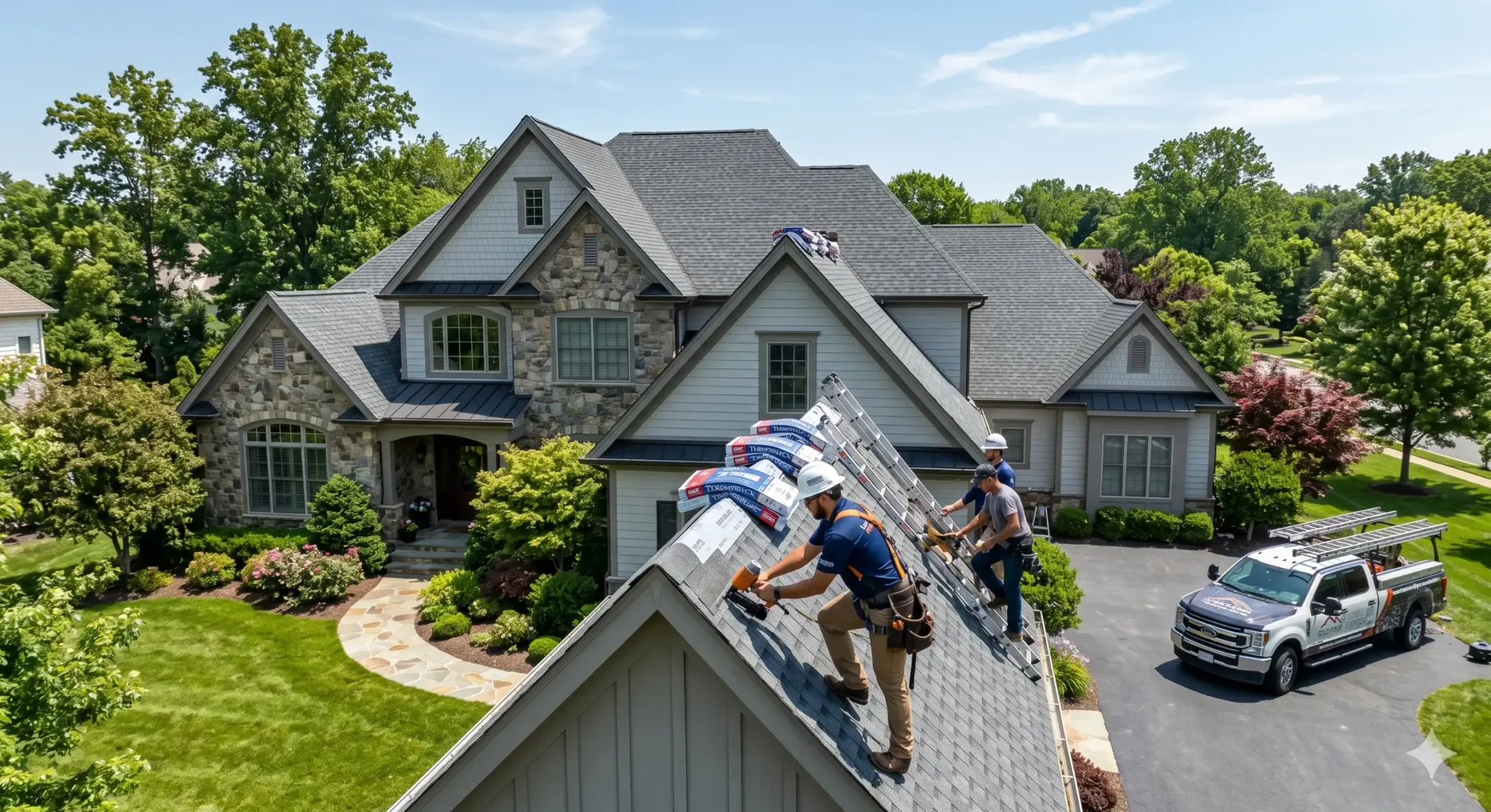
A typical residential roof replacement in Falls Church does not automatically require a building permit.
As of August 2026:
City of Falls Church: On a single-family house, the City states that you can replace the roof without a building permit as long as you are not replacing rafters or a major portion of the roof decking.
Fairfax County: The County lists replacement of roof shingles as work that does not require a residential building permit. It also exempts replacement of less than 256 square feet, or nine boards, of roof plywood, unless the decking must be fire-rated, such as in certain townhome conditions.
That means the useful question is not simply “Does roof replacement require a permit in Falls Church?” It is: “Which jurisdiction is this property in, and does the actual roofing scope stay within that jurisdiction’s permit exemption?”
Permit requirements can change, and project-specific conditions can alter the answer, so the scope should be checked against the current jurisdiction rules before work starts.
This is the part homeowners most often overlook.
A Falls Church mailing address does not necessarily mean the property is located inside the City of Falls Church.
The City’s own Address Finder explains that many Falls Church mailing addresses are actually in Fairfax County, including areas such as Merrifield, Seven Corners and Bailey’s Crossroads. The City provides an address-search tool specifically for confirming whether a property lies inside City limits.
That distinction matters because roofing permit rules are administered by the jurisdiction where the property is physically located.
| Property jurisdiction | Ordinary residential reroof | When permit questions become more important |
|---|---|---|
| City of Falls Church | Single-family roof replacement can be performed without a building permit when rafters and a major portion of decking are not being replaced | Structural/framing work, substantial decking replacement, multifamily or commercial scope |
| Fairfax County | Replacement roof shingles are permit-exempt; less than 256 sq. ft. of roof plywood is also exempt in qualifying residential situations | Larger decking replacement, work outside the listed exemption, structural scope or property types treated under commercial code |
These are not interchangeable rules.
The City’s current guidance is unusually direct.
For a single-family home, roof replacement does not require a building permit as long as the project does not involve replacing rafters or a major portion of the decking. That covers the type of reroof many homeowners have in mind:
The critical boundary is underneath the finished roofing.
If removal exposes conditions requiring substantial roof-deck replacement or work to rafters or other structural framing, the project can move outside the City’s ordinary permit exemption.
The City’s public homeowner guidance uses the phrase “major portion of the decking” but does not assign a square-foot quantity to that phrase on its permit-requirement page.
That means a contractor should not invent a numerical City threshold based on another jurisdiction’s rules.
If tear-off reveals substantial sheathing damage, the responsible next step is to determine whether the expanded scope changes the City’s permit requirement before proceeding with work that falls outside the original exemption.
Fairfax County handles the issue differently.
Its current Land Development Services guidance says a residential building permit is not required for replacement of roof shingles. It also states that replacement of less than 256 square feet, or nine boards, of roof plywood does not require a permit, with an exception where fire-rated decking is required, such as certain townhome applications.
This creates a useful distinction during reroofing:
Fairfax County’s residential permit library separately lists reroofing and roof repair under its Residential Miscellaneous permit category when the work requires permitting, which is why the actual scope matters more than the word “reroof” by itself.
Roof decking, also called sheathing, is the structural surface beneath the roofing system.
Its condition is not always fully visible before the old roof covering is removed. A project can therefore begin as an ordinary reroof and expose:
That discovery affects more than the roofing estimate. It can affect the permit classification.
City of Falls Church: The relevant dividing line is whether the project begins replacing rafters or a major portion of the decking.
Fairfax County: The County provides a more specific residential decking exemption: less than 256 square feet, or nine boards, subject to the stated fire-rated exception.
This is why the roofing proposal should explain what happens if deteriorated decking is discovered after tear-off.
A reroof generally means replacing roofing on an existing roof structure.
A new roof can involve a very different scope. If work includes:
the project has moved beyond ordinary covering replacement.
Fairfax County explicitly lists additions, including dormers and second-story additions, among residential projects requiring permits. The City likewise states that work involving rafters and other structural components requires permitting.
If your project is a new roof assembly rather than an ordinary reroof, our roof installation page covers the roofing-system and workmanship side of that project.
For a complete reroof of an existing home, see our dedicated roof replacement service.
The single-family exemptions above should not automatically be applied to every building with a Falls Church address.
The City specifically warns that multifamily and commercial construction has different permit requirements from its single-family homeowner guidance.
Fairfax County also notes that some properties people commonly think of as residential, including apartment buildings and condominiums, are treated as commercial under the building code and therefore use commercial permit pathways.
So before applying a residential reroof exemption, confirm the jurisdiction, the building type and the actual roofing scope.
That three-part check is more reliable than assuming the same rule applies to every roof.
When a permit becomes necessary, the homeowner does not necessarily need to manage the process personally.
The City of Falls Church says that while owners can obtain permits in certain circumstances, if a contractor is performing the work, the City recommends having the permit issued to the contractor. The contractor must provide the required Virginia contractor-license information as part of the process.
Fairfax County gives similar practical guidance. Property owners may obtain residential permits themselves, but the County strongly recommends that a properly licensed contractor pull the permit as the responsible party.
For a homeowner, that means one useful contractor question is: “If this scope requires a building permit, who is pulling it and who is responsible for the required inspections?”
The answer should be clear before work begins.
A permit isn’t simply a payment attached to the roofing proposal.
It creates a formal inspection and compliance path.
In the City of Falls Church, all work covered by a permit must be inspected, and the permit holder is responsible for requesting the required inspections.
Fairfax County likewise requires inspections once a permit has been issued and work reaches the applicable inspection stages.
The practical sequence therefore becomes:
City of Falls Church or Fairfax County.
Simple reroof, decking work, structural modification, new installation or another condition.
Apply the rules of the correct jurisdiction.
Preferably with responsibility clearly assigned before work begins.
The permitted work has to follow the jurisdiction's inspection process.
That sequence keeps permit coordination attached to the actual project rather than treated as paperwork after the roof is already open.
The word “inspection” can create confusion here.
A professional roof inspection is performed to evaluate roof condition and identify roofing problems.
A building inspection connected to a permit is performed by the jurisdiction as part of the permitted construction process.
They serve different purposes.
If you’re still trying to determine whether your project involves isolated roof-covering work or a broader condition affecting decking or structure, you can schedule a roof inspection before finalizing the roofing scope.
Once the scope is known, the permit requirement becomes much easier to determine.
This is the practical mistake worth avoiding.
Suppose a project clearly requires structural work but the permit question is ignored until after tear-off.
Now the property may be exposed while the scope is changing, permit responsibility is being determined, documentation may need to be submitted and inspection requirements are being clarified.
That is the wrong time to discover that project coordination was incomplete.
For work where structural or significant decking involvement is already expected, the permit path should be established during project planning.
For an ordinary reroof where concealed damage is uncertain, the contract should explain what happens if the scope changes after the roof is opened.
Permit coordination starts with defining the project accurately. Before larger work, the relevant questions include:
If the work remains permit-exempt, there is no benefit in creating unnecessary permit paperwork.
If the work requires a permit, that requirement should be addressed before the project reaches the stage where it affects scheduling.
Permit coordination is one local-project detail within SummitShield’s broader Falls Church roofing services.
You do not need to become an expert in local construction administration. Before work starts, ask four questions:
A roofer working locally should be able to explain how the permit question applies to the proposed roofing scope without pretending that every project has the same answer.
For a single-family home, not necessarily.
The City’s current guidance says a roof can be replaced without a building permit as long as the project does not involve replacing rafters or a major portion of the decking. Multifamily and commercial work follows different requirements.
For qualifying residential work, Fairfax County currently lists replacement of roof shingles as permit-exempt.
The permit question can change if the scope expands beyond simple shingle replacement.
Fairfax County currently exempts replacement of less than 256 square feet, or nine boards, of roof plywood for qualifying residential projects, unless the plywood must be fire-rated, such as in certain townhome conditions.
No.
The City states that not all Falls Church mailing addresses are inside City limits; many are located in Fairfax County. The property’s physical jurisdiction should be confirmed before applying permit rules.
Both jurisdictions allow owner involvement in certain circumstances, but their official guidance favors contractor responsibility when a licensed contractor is performing the permitted work. The City recommends the permit be issued to the contractor, and Fairfax County strongly recommends a properly licensed contractor pull residential permits.
If you’re planning roofing work in Falls Church, start with the address and the actual scope.
SummitShield Roofing can help identify whether you’re dealing with a straightforward reroof, significant decking work, structural roofing or a new installation and coordinate the roofing project accordingly.
Serving Falls Church, Arlington, Fairfax, McLean, Vienna, Alexandria, and Northern Virginia.
Call Now