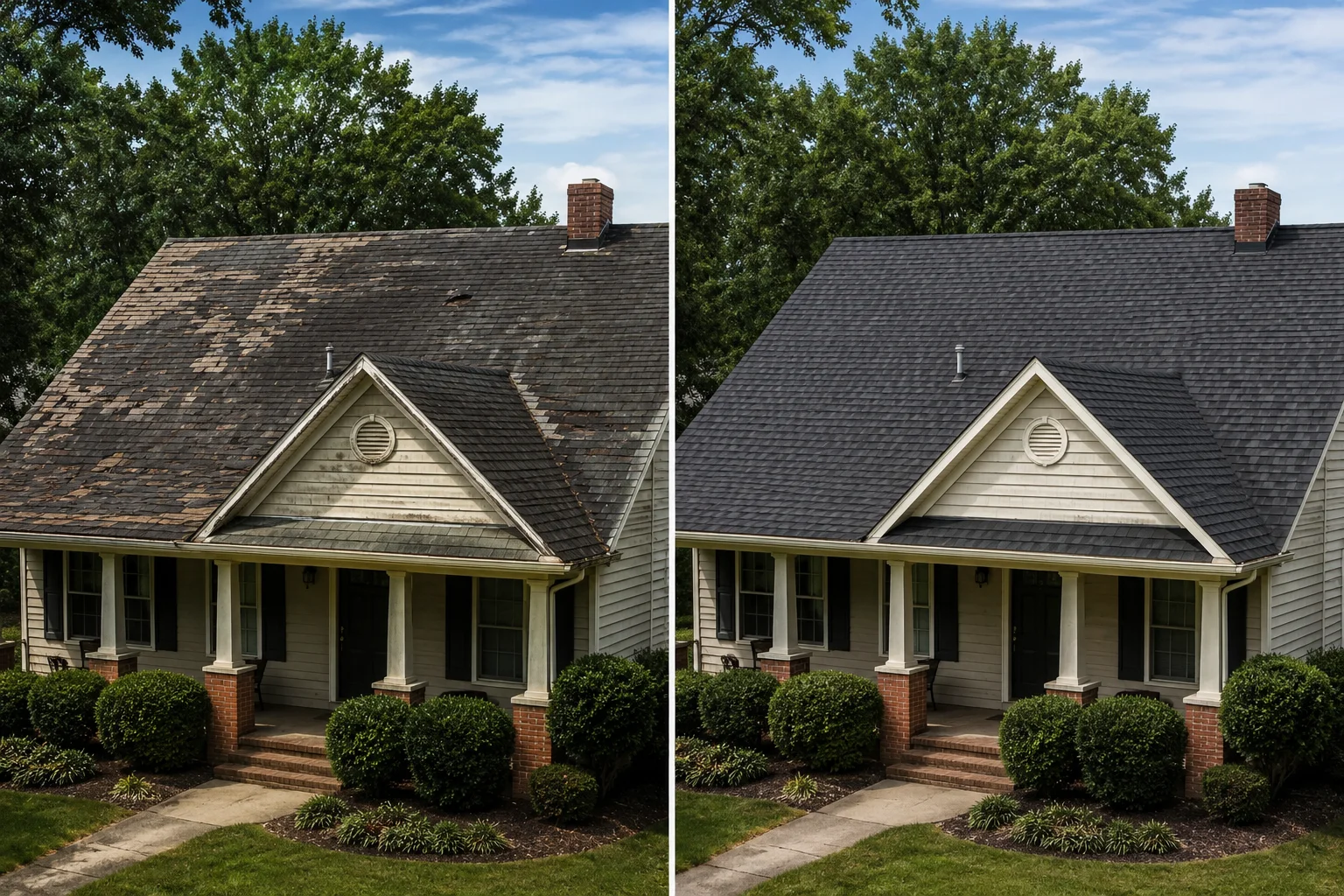
Replacement ScopeWhat Should Be Included in a Roof Replacement?
The visible shingles are only one part of the finished roof.
Major manufacturers describe residential roofing as a system of components rather than shingles alone, with products such as roof-deck protection, starter materials, field shingles, ridge caps and ventilation or other accessories designed to work together.
A SummitShield replacement project is scoped around the actual property, but the work typically follows several important stages.
01
Existing Roof Removal and Tear-Off
Where tear-off is part of the project, the existing roof covering is removed so the condition underneath can be evaluated.
Removal matters because the surface visible before the project doesn't always reveal what is happening at the roof deck, around old flashing or beneath previous repairs.
Tear-off also gives the crew access to details that should be corrected before the new roofing system covers them again.
02
Roof Deck and Sheathing Evaluation
Once the existing roofing is removed, the deck becomes visible.
The roof deck has to provide a suitable surface for fastening the new system. Soft, deteriorated or otherwise unsuitable sections shouldn't simply disappear beneath new underlayment.
If damaged decking is discovered, the affected area is identified and addressed as part of preparing a sound substrate for the new roof.
This is one of the reasons a good replacement proposal should explain how unforeseen decking conditions are handled.
03
Underlayment and Vulnerable Roof Areas
Underlayment provides a secondary layer beneath the finished roof covering.
The exact system depends on the roofing material and manufacturer requirements. Vulnerable areas and roof details may also require additional water-management protection based on the system being installed and the roof configuration.
The important point is that these layers should be specified as part of the roofing system rather than treated as an afterthought.
04
Flashing and Roof Transitions
A new roof shouldn't inherit failed details from the old one.
Chimneys, roof-to-wall intersections, penetrations, valleys and other transitions need to be evaluated as the existing roofing is removed.
Where flashing requires replacement or correction, it should be integrated with the new roof so water is directed onto the roof surface rather than relying on exposed sealant as the primary defense.
05
Starter, Field Roofing and Ridge Details
The finished roofing must be installed according to the requirements of the selected system.
That includes details such as starter materials at the roof perimeter, field-shingle layout and exposure, fastening, hip and ridge components and integration with flashing and penetrations.
These aren’t decorative details. They are part of how the roof sheds water and resists weather over time.
06
Ventilation Review
Roof replacement creates an opportunity to evaluate ventilation as part of the roofing system.
Where ridge exhaust or other attic ventilation is used, the system has to be considered together with appropriate intake rather than simply adding more exhaust.
We evaluate existing ventilation where it is relevant to the roof design and replacement scope rather than automatically reproducing an ineffective configuration.