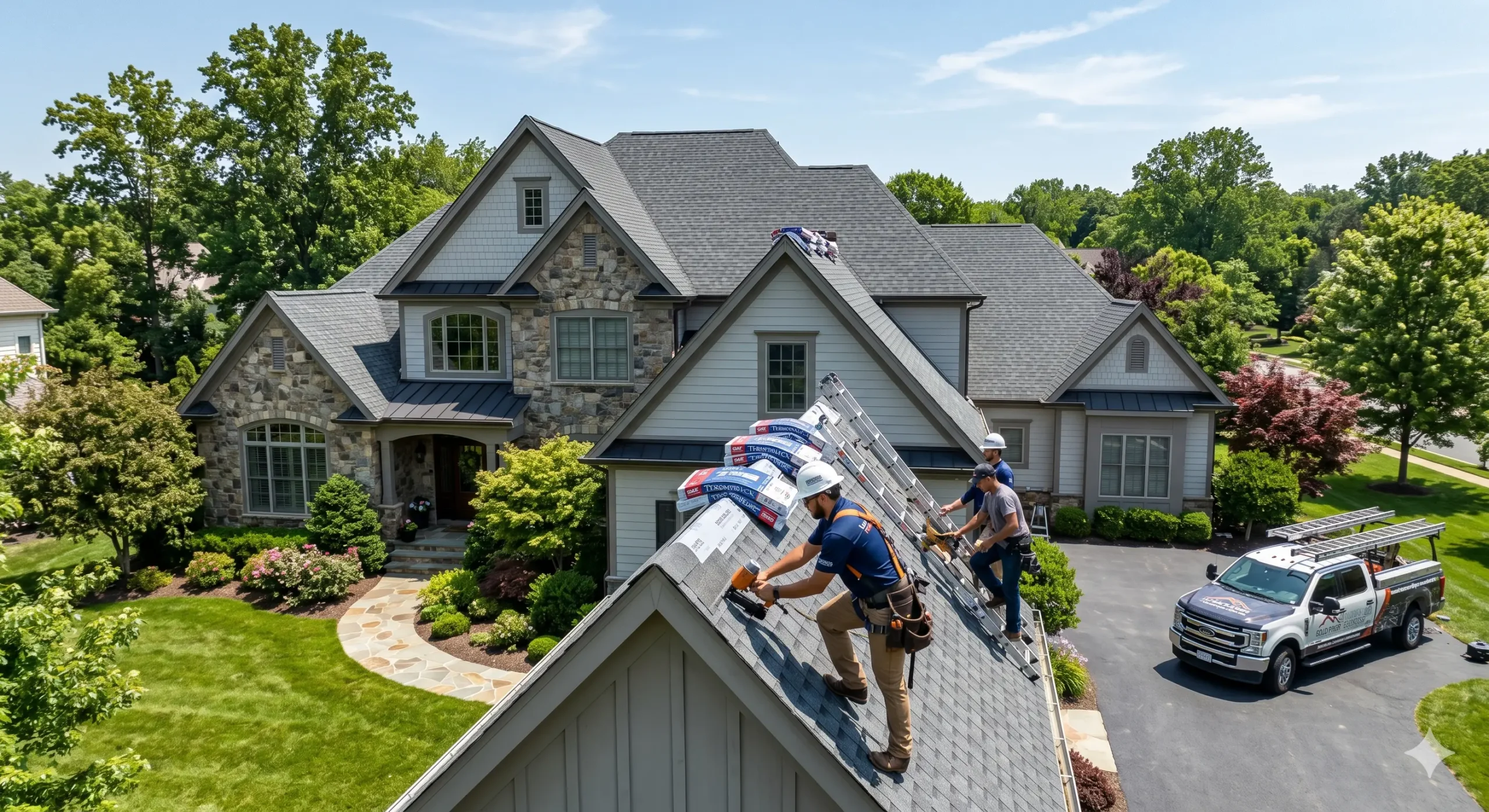
Roof Inspection in Falls Church, VA — HAAG Certified Inspectors, Written Reports That Actually Tell You Something
Licensed • Insured • Serving Falls Church, Arlington, Fairfax, McLean, Vienna & Alexandria
Most Homeowners in Falls Church Do Not Know What Is Actually on Their Roof
Think about that for a moment. You insure your roof. You depend on it to protect everything inside your home. You will spend $10,000–$20,000 replacing it when the time comes. And most homeowners have not had a professional set foot on it since the last contractor finished their work — possibly years or decades ago.
A roof does not announce its problems. It does not send a notification when flashing begins separating from the chimney, when granule loss crosses the threshold into accelerated UV damage, or when attic ventilation has become so inadequate that shingles are baking from underneath. It just quietly deteriorates — until a ceiling stain, an insurance claim, or a home sale inspection forces the issue.
A professional roof inspection changes that dynamic. It gives you accurate, current, documented information about the single most important protective system on your property — so that decisions about maintenance, repair, replacement, insurance, and home purchase are made with real data rather than assumption.
We provide every type of roof inspection Northern Virginia homeowners, buyers, and property managers need:
What Makes a HAAG Certified Roof Inspection Different
Not all roof inspections are equal. A general contractor walking your roof and telling you it looks fine is not a roof inspection. A home inspector checking a box that says "roof — no visible damage" from a ladder at the eave is not a roof inspection. A roofing salesperson climbing up to identify reasons why you need a replacement is not a roof inspection.
A HAAG-certified roof inspection is a structured, systematic evaluation performed by an inspector trained and certified by HAAG Engineering — the industry's leading independent authority on roof damage assessment, impact testing, and failure analysis. HAAG certification is the credential that insurance company field adjusters carry when they evaluate storm damage claims. It represents a defined standard of knowledge about how roofing systems perform, how they fail, and how to distinguish storm-caused damage from age-related wear.
What this means for you: when our HAAG-certified inspector produces a written report on your Falls Church roof, that report carries the same technical credibility as the document your insurance adjuster would produce. It identifies damage with specificity — not generality. It separates causes. It documents conditions with photographs that hold up in an insurance review, a real estate negotiation, or a contractor dispute.
This distinction matters in ways that affect your finances directly — particularly in the context of insurance claims and home purchase negotiations.
Types of Roof Inspections We Perform in Falls Church, VA
Different situations call for different inspection scopes. We tailor every inspection to its specific purpose — so the report you receive answers the questions you actually need answered.
Pre-Purchase Roof Inspection
Buying a home in Falls Church, McLean, Vienna, or anywhere across Northern Virginia is one of the largest financial decisions most families make. The standard home inspection gives a roof a cursory review — often from ground level or the attic hatch — that is entirely inadequate for a system that may need $15,000 in work within the next three years.
Our pre-purchase roof inspection is a complete, documented evaluation that tells you:
- The roofing material type, approximate age, and estimated remaining service life
- Current condition of shingles, flashing, ridge cap, gutters, fascia, and soffit
- Attic ventilation status and signs of prior moisture damage to sheathing and insulation
- Active or past leak evidence — water staining patterns, mold indicators, compromised decking
- Specific repair or replacement needs and approximate cost range
- Whether the roof is insurable in its current condition under standard homeowners policies
This report gives you negotiating leverage before closing, realistic budget expectations for your first years of ownership, and documented evidence of known issues that transfers liability appropriately between buyer and seller. A pre-purchase roof inspection is not optional on a home with a roof over 10 years old. The cost of the inspection is negligible against what it protects you from.
Annual Maintenance Inspection
The National Roofing Contractors Association recommends professional roof inspection twice per year — spring and fall — for residential roofs. Once per year is the practical minimum for Falls Church homeowners who want to manage their roof proactively rather than reactively.
An annual maintenance inspection identifies developing problems while they are still inexpensive to address. A displaced piece of step flashing caught at an annual inspection is a $200 repair. The same displaced flashing missed for three years is a water-damaged rafter, rotted sheathing, and a mold remediation situation that costs ten times more and may not be fully covered by insurance because the damage accumulated gradually rather than from a sudden event.
Annual inspections also build a documented history of your roof's condition — a record that supports insurance claims, demonstrates proactive maintenance, and provides a clear picture of how the system is aging for future replacement planning.
Post-Storm Inspection
After any significant weather event affecting Falls Church — hail, high-wind thunderstorm, derecho, ice storm, or tropical storm remnant — your roof needs a professional assessment regardless of whether interior leaking has begun.
As we explain on our storm damage page, the most consequential storm damage to a residential roof is often invisible from the ground and does not produce interior water intrusion until weeks or months after the event. Hail impact that fractures the asphalt mat beneath intact granules, wind damage that breaks sealant bonds between shingles, flashing separation at chimney or skylight penetrations — none of these are visible from your yard.
A post-storm inspection by our HAAG-certified team identifies and documents all storm-caused damage in the format that insurance adjusters use to evaluate claims. The timing of this inspection relative to your insurance claim filing matters — contact us within 7–14 days of any significant weather event to protect your claim window.
Insurance Inspection & Claim Support
When you file a homeowners insurance claim for roof damage, your carrier sends an adjuster to inspect the property. The outcome of that inspection — how thoroughly damage is identified and documented — directly determines your claim payout.
Our HAAG-certified inspectors perform pre-claim inspections that give you a complete damage picture before your adjuster arrives, can be present on-site during the adjuster's inspection to point out specific damage areas and provide technical context, and produce supplemental documentation when an adjuster's initial assessment misses or undervalues damage.
We have helped Falls Church homeowners recover full replacement cost on claims that were initially approved for partial repair — because our documentation provided evidence the adjuster's brief visit did not capture. We do not negotiate with insurance companies on your behalf — that is your agent's role — but we provide the technical documentation that gives your claim the strongest possible foundation.
Seller Pre-Listing Inspection
If you are preparing to sell your Falls Church home, a roof inspection before listing gives you two specific advantages. First, it tells you whether your roof will survive the buyer's inspection process or whether it will create a last-minute negotiation obstacle that costs you more than a proactive repair would have. Second, a recent, documented inspection report from a HAAG-certified inspector is a credible disclosure document that demonstrates seller transparency — a meaningful differentiator in Falls Church's competitive real estate market.
Discovering that your roof has significant issues at the buyer's inspection — after you have an accepted offer and a closing date — puts you in the worst possible negotiating position. Discovering it six weeks earlier gives you options.
Commercial Property Inspection
Commercial roofing systems — flat membranes, standing seam metal, built-up roofing — require inspection by someone with commercial roofing knowledge, not a residential inspector applying residential criteria to a TPO membrane or modified bitumen system.
We perform commercial roof inspections for property managers, building owners, facilities directors, and commercial real estate transactions across Falls Church, Fairfax, Arlington, and Northern Virginia. Commercial inspection reports include membrane condition assessment, drain and penetration evaluation, seam integrity documentation, and estimated remaining service life — in a format appropriate for property management records, capital planning, and commercial real estate due diligence.
New Construction Final Inspection
Before a newly installed roof on a new build or renovation project is closed out, an independent inspection verifies that installation was completed to manufacturer specifications and Virginia building code requirements. We perform new construction roof inspections for homeowners, general contractors, and developers who want independent verification of installation quality before the builder's warranty period begins.
What Our Roof Inspection Covers — Every System, Every Component
A roof inspection is only as valuable as its completeness. We evaluate every component of your roofing system — not just the shingles visible from the peak.
Roof Surface Evaluation
- Shingle condition: granule coverage, surface cracking, blistering, curling, cupping, delamination
- Impact damage assessment: hail bruising, branch strike marks, surface fractures
- Wind damage: lifted corners, broken sealant strips, displaced or missing shingles
- Algae and moss growth: coverage extent, penetration depth into shingle surface
- Ridge cap integrity: alignment, coverage, fastening pattern
- Overall age estimation based on visual wear pattern and material type
Flashing Inspection
Flashing failure is the leading cause of residential roof leaks in Northern Virginia. We inspect every flashing component:
- Step flashing at all wall-to-roof transitions
- Chimney base flashing, counter-flashing, and saddle
- Skylight curb and step flashing integration
- Dormer flashing at rake and eave transitions
- Valley flashing — open metal, closed cut, or woven
- Drip edge condition and integration with underlayment
- Pipe boot and penetration flashing for all vents and conduit
Gutter & Drainage Assessment
- Gutter attachment, slope, and alignment
- Downspout condition and discharge location
- Granule accumulation in gutters — an indicator of shingle wear rate
- Ice dam vulnerability assessment at eave overhangs
- Fascia and soffit condition beneath gutters
Attic Inspection
The attic reveals what the roof surface conceals. We access your attic and assess:
- Active or historic water intrusion — staining patterns on sheathing and rafters
- Decking condition: rot, delamination, soft spots, nail pull-through
- Ventilation balance: ratio of intake at soffits to exhaust at ridge
- Insulation condition: moisture saturation, displacement, R-value adequacy
- Signs of mold or mildew on structural members
- Daylight penetration through the roof assembly indicating gaps or failures
Structural Observation
- Visible rafter and truss condition from attic
- Roof plane flatness — sagging or waviness indicating structural movement
- Decking attachment pattern and evidence of prior repairs
What You Receive — The Inspection Report
A verbal summary at the end of an inspection is not a roof inspection report. You need a document — something you can give to your insurance adjuster, your real estate attorney, your contractor, or your HOA — that records what was found, where, and what it means.
Every inspection we perform produces a written report that includes:
Executive summary
A plain-language overview of the roof's current condition, overall assessment, and priority action items. Written for a homeowner, not a roofing contractor.
Section-by-section findings
Documented condition of every roof component evaluated, organized by roof section (front slope, rear slope, dormers, flat addition, etc.).
Photographic documentation
Timestamped photographs of every condition noted, organized to correspond with the written findings. Each photo is labeled with its location on the roof and what it shows.
Damage classification
Where applicable, damage is classified by cause: storm-caused vs. age-related vs. installation defect vs. maintenance-related. This classification directly affects insurance claim eligibility and is a specific capability of HAAG-certified inspectors.
Remaining service life estimate
Based on material type, observed wear pattern, and current condition, we provide an estimated remaining useful life range for the current roofing system.
Recommended action scope
Specific recommendations organized by priority: immediate action needed, recommended within 12 months, plan within 3 years, monitor at next inspection.
This document is yours. It belongs to you. We do not withhold it pending a repair sale or condition it on using our services for any follow-up work.
Roof Inspection Insights Specific to Falls Church & Northern Virginia Homes
Fifteen years of inspecting roofs across Falls Church, Arlington, Fairfax, McLean, and Vienna has given us a clear picture of the specific patterns and problems that show up repeatedly on homes in this region.
Inadequate attic ventilation is the most common finding
Inadequate attic ventilation is the most common finding on homes built between 1950 and 1990 across Falls Church and Arlington. The ventilation standards these homes were built to are significantly below current requirements — and the consequences are visible in premature shingle aging, decking moisture damage, and ice dam vulnerability that we document on the majority of inspections in these neighborhoods.
Improper chimney flashing is a close second.
The step flashing and counter-flashing systems on older Falls Church homes were frequently installed without saddles at the uphill chimney face — a standard detail that prevents water from channeling directly behind the chimney and into the roof deck. We find this omission on a large percentage of chimney inspections on homes built before 1980.
Valley deterioration shows up earlier than most homeowners expect
Valley deterioration shows up earlier than most homeowners expect on homes with open-cut asphalt valleys rather than metal valley systems. Northern Virginia's rainfall volume — averaging 42 inches annually — concentrates significant water volume through roof valleys, and shingle valleys that were appropriately cut at installation narrow over time as surrounding shingles curl and shift.
Granule loss patterns tell specific stories
Granule loss patterns tell specific stories on Falls Church roofs. Uniform granule loss across a shingle field indicates age-related wear. Circular or dimpled granule displacement patterns indicate hail impact. Granule loss concentrated at low-slope sections indicates poor drainage and water retention. We read these patterns as part of every inspection and document what they indicate.
Tree debris accumulation is nearly universal
Tree debris accumulation in valleys and at eave sections is nearly universal across Falls Church's heavily canopied neighborhoods. Debris that holds moisture against shingles creates accelerated granule loss, moss establishment, and localized shingle deterioration that shortens service life in specific sections of the roof long before the overall system needs replacement.
Service Areas — Roof Inspections Across Northern Virginia
We perform residential and commercial roof inspections throughout Northern Virginia, including local roof inspection near me searches in Falls Church neighborhoods and nearby ZIP codes.
We work directly with real estate agents, buyers, sellers, property managers, and insurance professionals across all of these communities on inspection scheduling and report delivery timelines that fit transaction and claim deadlines.
Frequently Asked Questions — Roof Inspection in Falls Church, VA
Schedule Your Roof Inspection in Falls Church, VA Today
Your roof is working right now — deflecting rain, managing heat, protecting your insulation, your framing, your ceilings, and everything your family keeps inside. You just cannot see it doing that work. And you cannot see it when it begins to fall short.
A professional inspection by a HAAG-certified inspector gives you the documented picture of your roof's actual condition — not a guess, not a visual from the yard, not a home inspector's checkbox. A real assessment that tells you exactly where things stand and what, if anything, needs to change.
One inspection. A written report. Accurate information to make a well-informed decision about one of the most significant systems on your property.
TL;DR — Roof Inspection Falls Church, VA
A professional roof inspection in Falls Church by a HAAG-certified inspector covers every component of your roofing system — surface materials, flashing, gutters, attic, and structural elements — and produces a written report with photographic documentation, damage classification, remaining service life estimate, and prioritized action recommendations. We perform pre-purchase, annual maintenance, post-storm, insurance support, pre-listing, commercial, and new construction inspections across Falls Church, Arlington, Fairfax, McLean, Vienna, Alexandria, and Northern Virginia. The inspection report is yours — no obligation attached. Call now to schedule.