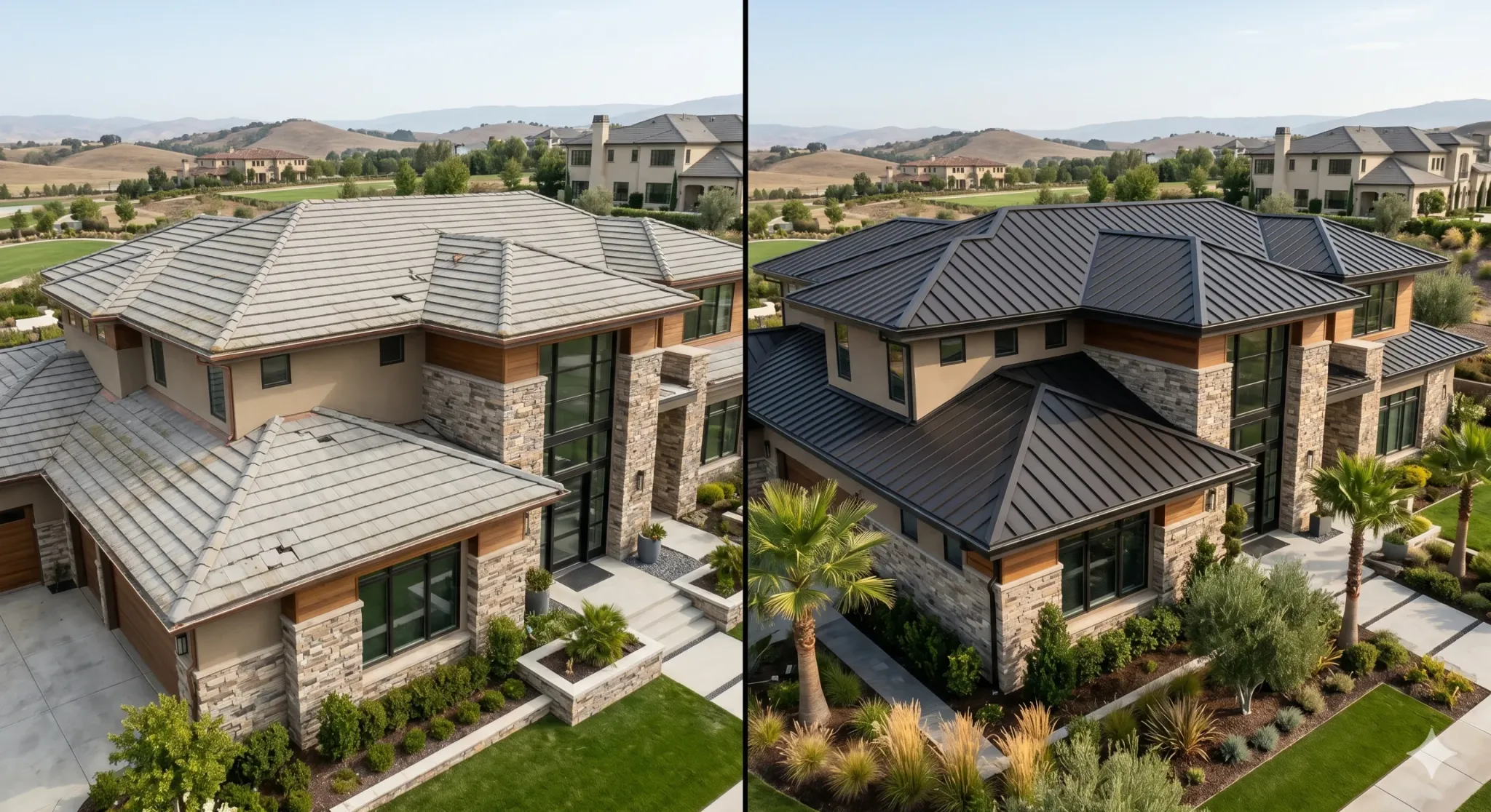
Overall Roof Views
These establish roof configuration and the general location of affected sections.

A roofing contractor’s role in an insurance claim should be clear: inspect the roof, document the physical condition, explain the roofing damage, and prepare an accurate scope and estimate for the work that is actually needed.
For a storm-related roofing claim, we can provide:
We do not promise claim approval, tell an insurer what it must cover or act as your public adjuster.
Virginia law treats public adjusting as a licensed activity involving representation, advice or negotiation directed toward settling a first-party property insurance claim.
That boundary protects the homeowner as much as the contractor.
| Part of the process | Homeowner | Roofing contractor | Insurance company / adjuster |
|---|---|---|---|
| Report the loss | Yes | No | Receives claim |
| Review your policy | With insurer/qualified adviser | No | Explains carrier's position |
| Inspect roofing condition | May observe safely | Yes | May inspect for claim |
| Photograph roof damage | Yes | Yes | May document independently |
| Prepare roofing repair scope | No requirement | Yes | May prepare its own estimate |
| Price roofing work | No | Yes | May estimate covered loss |
| Decide policy coverage | No | No | Yes |
| Approve or deny claim | No | No | Yes |
| Perform roofing work | No | Yes | No |
| Negotiate claim for homeowner | Homeowner or properly authorized/licensed representative | Not SummitShield's roofing role | Participates for insurer |
Virginia’s Bureau of Insurance explains that after a loss is reported, the insurer assigns a representative to examine the property and determine the amount the company will pay under the claim.
Insurance paperwork should not come before understanding the physical roof condition.
If a wind, hail or debris event may have affected the roof, the roofing question is: What changed, where is it located, and what roofing work would be required to correct it?
That may involve looking at:
A professional roofing assessment should also distinguish new event-related conditions from unrelated wear, previous repairs or existing deterioration.
That distinction matters because the roof may contain more than one condition at the same time.
A storm occurring on Tuesday does not automatically prove that every defect visible on Wednesday was caused by Tuesday’s storm.
A photograph of one damaged shingle can be useful. By itself, it may not explain enough.
Good roofing documentation should make it possible to understand what the photograph shows and where it exists on the roof. A useful photo record may include:
These establish roof configuration and the general location of affected sections.
These show whether an observed condition is isolated or appears across a broader slope.
These document specific shingles, flashing, vents, gutters, ridge material or other affected components.
Close-ups show the condition itself without losing the larger location context provided by other photographs.
If a storm is associated with water entry, photographs of interior staining or moisture can document the symptom while the exterior source is investigated separately.
Consumer insurance guidance from the NAIC recommends documenting property damage with photographs or video before damaged material is removed when possible.
The goal is not to create dramatic photographs. The goal is to create a factual visual record.
Photos are evidence. They are not automatically a roofing diagnosis.
A useful roof-damage record connects the photographs to observations such as:
SummitShield uses documented roof evaluation and photo documentation so the roofing scope can be tied back to actual conditions rather than relying on a vague statement that the roof was “storm damaged.”
A contractor should not decide the project size before understanding the damage.
The assessment needs to establish whether the roofing condition appears:
This is one of the most important distinctions in the claim process.
A roofing contractor’s estimate answers: What roofing work do we believe is necessary, and what will that construction work cost?
The insurance company’s estimate relates to: the carrier’s assessment of the claimed loss under the applicable insurance process and policy.
Those documents may not always be identical.
Virginia’s Bureau of Insurance specifically advises homeowners to obtain written estimates before major repairs and says that if a contractor’s cost differs materially from what the company’s representative has allowed, the homeowner should contact the insurance representative to address the discrepancy.
Depending on the damage, a roofing estimate may need to identify relevant items such as:
The roof should drive the scope.
The claim should not drive the roofer to invent work that the property does not need.
A difference does not automatically mean one side is dishonest. The two parties may:
The useful response is documentation.
SummitShield can explain the roofing basis for its estimate and provide supporting photographs or construction information about the work it proposes.
The homeowner and insurance company remain responsible for the claim and coverage discussion.
Virginia’s official disaster guidance tells policyholders to contact the insurer’s representative when there is a discrepancy between the contractor’s repair estimate and the amount allowed by the company.
An insurance adjuster may have questions about the location of damaged roofing, quantities, roof measurements, component condition, repairability, material requirements, or what was uncovered during construction.
A roofing contractor can answer those questions factually. For example:
“The pipe boot is physically split and requires replacement.” is a roofing observation.
“Your policy has to pay for this item.” is a coverage statement.
Those are not the same thing.
Virginia defines public adjusting broadly around acting for a policyholder to investigate, advise, negotiate or otherwise pursue settlement of a first-party property claim.
SummitShield’s role stays on the roofing side of that line.
If an adjuster is scheduled to inspect the property, organize the factual information you already have. Useful items may include:
The NAIC recommends keeping photographs, video and an inventory of damaged property as part of the claim record.
You should also keep your insurer’s claim number, adjuster contact information, written correspondence, and estimates and reports.
Virginia’s homeowner insurance guide recommends keeping records of communications with the insurance company, including dates, names and what was discussed.
If storm damage has created active water entry, preventing additional damage may become more urgent than waiting for a complete final roofing scope.
Virginia insurance regulations require certain homeowners-policy forms to cover reasonable repairs made to protect covered property from further damage when those repairs are directly attributable to a covered cause of loss, subject to the policy framework.
The practical approach is:
Do not perform unsafe rooftop work yourself after a storm.
Temporary stabilization and permanent roofing repair are not necessarily the same scope.
Cleaning up after storm damage is understandable.
But damaged material can also help establish what happened.
Virginia SCC guidance advises homeowners not to dispose of items believed to be a complete loss until the insurance representative has had an opportunity to examine them. The NAIC likewise recommends documenting damage before removing debris and retaining damaged items where practical if the insurer may need to inspect them.
For roofing work, practicality and safety matter.
If material has to be removed immediately to stop ongoing damage, document its condition carefully before disposal whenever reasonably possible and retain relevant receipts.
A legitimate roof scope should show the true roofing work and price.
It should not be manipulated to make an insurance deductible appear to disappear.
SummitShield does not create false roofing charges, inflated scopes or hidden side arrangements to alter the financial information presented in a claim.
Virginia insurance rules permit an insurer to void applicable policies for willful concealment, misrepresentation, fraud or false swearing concerning the insurance.
Your exact deductible and payment responsibility come from your insurance contract and insurer. Questions about how the deductible applies to your specific policy should be directed to the carrier or another appropriately qualified insurance professional.
No roofing contractor can responsibly promise:
The roofer can document physical conditions.
The carrier still applies the insurance contract.
Virginia’s own homeowners guide emphasizes that coverage depends on the particular policy and that consumers should work with their insurer or agent to understand benefits and exclusions.
If someone guarantees an insurance result before the carrier has evaluated the claim, that is not the same thing as providing roofing expertise.
An approved claim still does not install the roof. Once the insurance side has reached the point where roofing work can proceed, the construction side still requires:
If the approved roofing path involves correcting storm-related damage, our storm-damage roof repair page covers the actual roofing response.
This insurance-claims page stays focused on documentation and claim support.
Not every roofing condition is visible before materials are removed.
For example, removal of damaged roofing may reveal a decking condition that could not be confirmed from the finished surface.
The correct response is to document the newly observed condition before simply adding work.
That can include photographs, location, measurements or quantities, explanation of the roofing condition, and revised construction scope where appropriate.
Virginia SCC guidance tells homeowners to contact the insurer when a contractor discovers hidden damage or when repair costs differ from what the insurer initially allowed.
The documentation supports the conversation. It does not predetermine the insurance company’s decision.
SummitShield can stand behind its roofing observations, photographs, measurements and estimate.
We do not provide legal advice or represent homeowners in insurance disputes.
Virginia licenses public adjusters for policyholder representation in first-party property claims, and the SCC regulates their conduct and contracts.
If a homeowner has a dispute involving coverage or claim handling, the appropriate next contact may be the insurance company, the insurance agent, a properly licensed public adjuster where appropriate, legal counsel where appropriate, or the Virginia Bureau of Insurance.
The Virginia Bureau of Insurance provides consumer assistance and a formal complaint process for property-and-casualty insurance issues, although the Bureau notes that it cannot force an outcome unsupported by the law and facts.
A roofing contractor helping around a claim should make the construction side clearer, not more confusing. Look for:
Photos and observations should support the roofing recommendation.
The estimate should say what work is actually proposed.
Roof areas and quantities should be explainable.
Normal deterioration should not automatically be labeled storm damage.
The roofer explains roofing. The insurer explains insurance coverage.
Newly discovered conditions should be recorded rather than quietly added.
The roofing company should never promise what the insurer will approve.
That is the standard SummitShield follows when providing roofing documentation around an insurance claim.
Falls Church properties can present some specific documentation challenges because roofing is not always one simple rectangular plane. Homes may include:
After wind or falling debris, one part of a roof may be affected while another is untouched.
Good documentation should identify that distinction rather than describing the entire property simply as “damaged.”
SummitShield’s broader Falls Church roofing services are available when the assessment identifies roofing needs outside the storm-claim workflow.
Start with safe photographs of visible exterior and interior damage, record when the event occurred, keep relevant receipts and preserve claim correspondence.
A professional roofer can add roof-level photographs, measurements, affected components and a construction scope. The NAIC recommends documenting property damage with photos or video before cleanup where practical.
If you intend to make a claim or need instructions under your policy, your insurer or agent is the authoritative source for reporting requirements. Virginia SCC guidance directs homeowners to report a loss through their agent or insurer.
A roofer can separately establish what happened to the roofing system and document its physical condition. If you’re unsure whether roof damage is actually present, schedule a roof inspection.
SummitShield can provide roofing documentation and answer factual construction questions about the roof and proposed scope.
The insurance adjuster remains responsible for the insurer’s claim evaluation, and SummitShield does not act as the homeowner’s public adjuster or determine coverage.
Ask the contractor to explain the roofing basis for the disputed item and provide supporting documentation.
Virginia SCC guidance advises contacting the insurance representative when a contractor’s estimate differs from the amount allowed or hidden damage is discovered. The carrier then determines how the additional information affects the claim.
No.
Physical storm damage and insurance coverage are separate questions.
A roofer can evaluate whether roofing was damaged and determine an appropriate construction scope. The insurer applies the terms of the policy and makes the coverage determination. Virginia SCC guidance makes clear that not every disaster-related loss is covered under every homeowners policy.
If wind, hail or falling debris may have affected your roof, start with the physical condition of the roofing system. Tell SummitShield Roofing:
when the event occurred; what you noticed afterward; whether water entered the property; whether you already have a claim number; whether an adjuster has inspected the roof; whether you have received an insurance estimate.
We’ll focus on the roofing: inspecting, documenting and defining the work that the roof actually requires.
Serving Falls Church, Arlington, Fairfax, McLean, Vienna, Alexandria, and Northern Virginia.
Call Now