1. Determine What the Roof Needs
The roofing condition comes first. You should know whether the recommended work is:
- 1localized
- 2a larger corrective scope
- 3complete replacement
- 4another defined roofing project

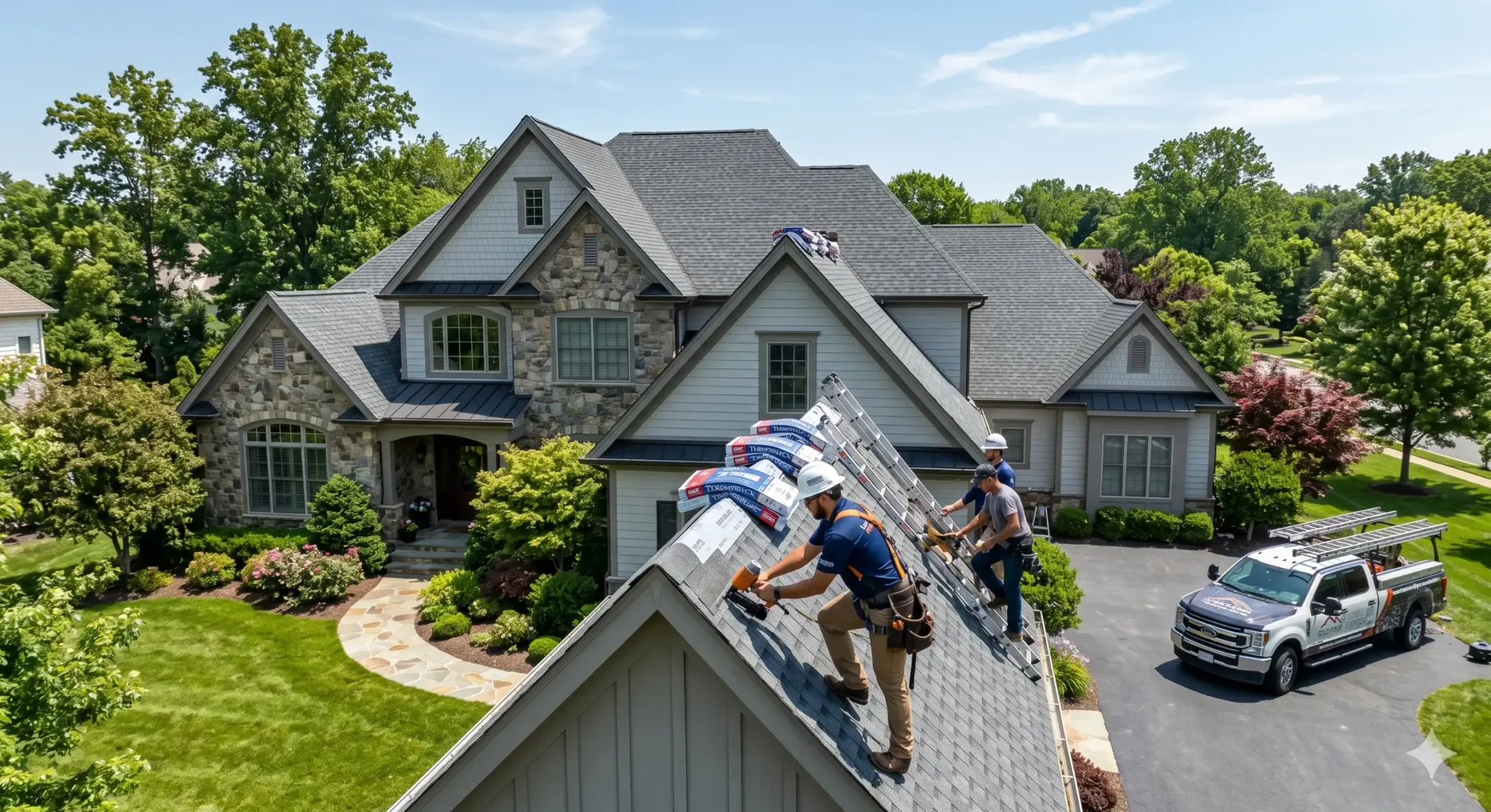
Roof financing lets an eligible homeowner pay for qualifying roofing work over time instead of paying the entire project cost at once.
The right order is: determine the roofing scope → establish the project price → review financing terms → decide whether the payment structure works for you.
Not the other way around.
A low advertised monthly payment should never determine what roofing work your property receives.
Before discussing how to finance a project, you need to know what you are actually financing.
For a replacement, the written roofing scope may account for items such as:
Financing changes how the project is paid for.
It should not change the roofing diagnosis or cause a contractor to recommend a larger project merely because financing is available.
If the actual roofing need is a complete roof replacement, that page explains the roofing project itself. This page stays focused on paying for the agreed scope.
Monthly payment is not the same thing as roof cost.
Suppose two financing structures create different monthly payments. The lower monthly payment may simply result from a longer repayment term, a different interest rate, different fees, or a different amount financed.
The Consumer Financial Protection Bureau explains that APR incorporates the loan’s interest rate plus certain additional loan fees, making it an important measure when comparing borrowing costs.
That is why homeowners should first understand the underlying roofing estimate. For project-pricing context and the factors that affect the scope, see our guide to roof replacement cost.
The exact financing process depends on the provider and program, but the practical sequence should remain clear.
The roofing condition comes first. You should know whether the recommended work is:
The estimate establishes the amount of roofing work being considered.
A customer should understand the project itself before deciding whether to finance it.
If financing is appropriate, SummitShield can explain the current financing option associated with the project. The financing provider—not the roof itself—determines matters such as:
Do not rely on a verbal description such as: "It’s only a few hundred dollars a month." Review the written terms.
The Federal Trade Commission advises consumers not to agree to contractor-arranged home-improvement financing without understanding the loan and comparing its terms with other options.
These are two separate decisions: Do I agree with the roofing work? and Do I agree with the financing?
You should be comfortable with both before proceeding.
Do not compare financing by monthly payment alone. Look at the complete offer.
| Financing detail | Why it matters |
|---|---|
| Amount financed | Shows how much project cost is actually being borrowed |
| APR | Helps show borrowing cost including interest and certain fees |
| Interest rate | Determines part of the borrowing cost |
| Loan term | Affects monthly payment and how long payments continue |
| Monthly payment | Shows the recurring payment obligation |
| Fees | Can increase the overall cost |
| Total repayment | Shows what the financing may cost over the full term |
| Promotional terms | May have deadlines or conditions |
| Prepayment terms | Determine what happens if you pay the balance early |
| Approval conditions | Explain whether the offer is actually available to you |
CFPB guidance recommends comparing APR, interest rate, loan length and amount financed rather than judging a loan only from the payment amount.
This distinction matters when homeowners compare roof payment options.
The interest rate is the cost charged for borrowing the principal.
The APR, or annual percentage rate, reflects the interest rate plus certain additional fees associated with the loan.
That means two offers that appear to have similar interest rates can still have different borrowing costs.
When financing terms are presented, look beyond the headline number.
This is one of the easiest financing concepts to miss.
Spreading the same financed amount across more months can reduce the monthly payment.
But it may also change the total amount paid over time, depending on the interest rate and fees.
So when a financing offer emphasizes “Lower monthly payment,” also ask: “What is the term, and what will I pay in total if I follow the full payment schedule?”
CFPB loan guidance explains the general tradeoff: longer loan terms tend to reduce monthly payments while potentially increasing the total borrowing cost.
A roofing proposal should remain understandable even when financing is involved.
You should be able to distinguish the roofing project price from the cost of borrowing money to pay for that project.
Those are different numbers.
This makes it easier to compare the roof scope, contractor proposals, payment methods and lender offers.
It also prevents a monthly payment from disguising unnecessary additions to the project.
Financing can be used for qualifying roofing projects when the homeowner and project meet the applicable financing requirements.
SummitShield currently advertises financing availability for its roofing work.
However: financing available does not mean financing guaranteed.
Approval, credit criteria, amounts and terms depend on the financing provider and the applicant. For that reason, SummitShield does not promise:
unless those terms are actually contained in the financing offer applicable at that time.
Financing becomes relevant when the roof scope is justified but paying the full project amount immediately would create a cash-flow problem.
For example, a homeowner may have already determined that widespread roofing deterioration requires replacement. The technical decision has already been made.
The remaining question is: How should the approved project be paid for?
Financing can separate the project timing from the need to provide the entire project price in one payment.
What it should not do is turn a repairable roof into a replacement merely because financing is available.
The roofing recommendation must continue to follow condition.
These topics can overlap in a homeowner’s mind, but they are separate.
Financing concerns: how you pay for the roofing project.
Insurance concerns: whether a covered loss falls within the terms of an insurance policy.
Do not assume financing availability means insurance will reimburse the project, and do not assume a potential insurance claim automatically eliminates the need to consider payment.
This page does not evaluate insurance coverage or claim outcomes.
Yes.
A contractor-associated financing path can be convenient, but convenience is only one factor.
The FTC specifically recommends shopping around and comparing financing terms rather than automatically accepting financing arranged through a home-improvement contractor.
Depending on your own circumstances, homeowners may independently consider other lawful payment or borrowing sources available to them.
SummitShield’s role is to explain the roofing scope and the financing pathway available through the roofing project—not to tell you which outside financial product is best for your personal finances.
Before accepting a financing offer, you should be able to answer these questions:
Keeping responsibilities separate makes the project easier to understand.
The roofing side handles matters such as:
The financing side determines:
SummitShield should not represent a conditional lender approval as guaranteed.
Likewise, lender approval does not determine whether a roofing scope is technically appropriate.
This is the standard we want homeowners to use.
A roofing specialist should be able to explain why the roofing work is needed before explaining how payments could be structured.
If a contractor cannot justify the roof scope without discussing financing, the order is backward.
For a replacement project, you should understand why replacement is recommended, what is included, which system is proposed and what the project costs—before evaluating financing.
That keeps the roofing decision tied to the property rather than the payment mechanism.
Roof project costs can vary because Falls Church properties are not identical.
Roof size, pitch, multiple roof planes, dormers, chimneys, additions, decking conditions and the roofing system selected can all influence scope.
This financing page does not duplicate those pricing calculations. Its purpose is to make sure that once the project amount is known, the payment decision remains equally clear.
For roofing needs outside replacement financing, SummitShield’s broader Falls Church roofing services route homeowners to the appropriate roofing service.
Financing is available through SummitShield for qualifying roofing projects.
Specific approval, amount, rate and repayment terms depend on the applicable financing program and applicant eligibility.
You should at least understand the roofing scope and estimated project amount before making a final financing decision.
That allows you to evaluate financing against the actual work instead of choosing a roof based primarily on an attractive monthly payment.
No approval should be treated as guaranteed.
Credit decisions, eligibility and financing terms are determined under the applicable financing program.
Not necessarily.
A lower payment can be produced by a longer repayment term and does not necessarily mean lower total cost. Compare APR, loan length, fees, total amount financed and other terms.
Yes.
The FTC recommends shopping around and understanding loan terms before agreeing to contractor-arranged home-improvement financing.
If roofing work is needed but paying the entire amount at once is a concern, start with the roof.
SummitShield Roofing can help establish what work is actually needed, what the project scope includes, what the roofing estimate is, whether financing is available for that project, and what the next financing step involves.
You can then review the applicable financing terms and decide whether they fit your situation.
Serving Falls Church, Arlington, Fairfax, McLean, Vienna, Alexandria, and Northern Virginia.
Call Now