Location
Which roof section, penetration, drainage area or interior zone is affected?
A commercial roofing problem affects more than the roof.
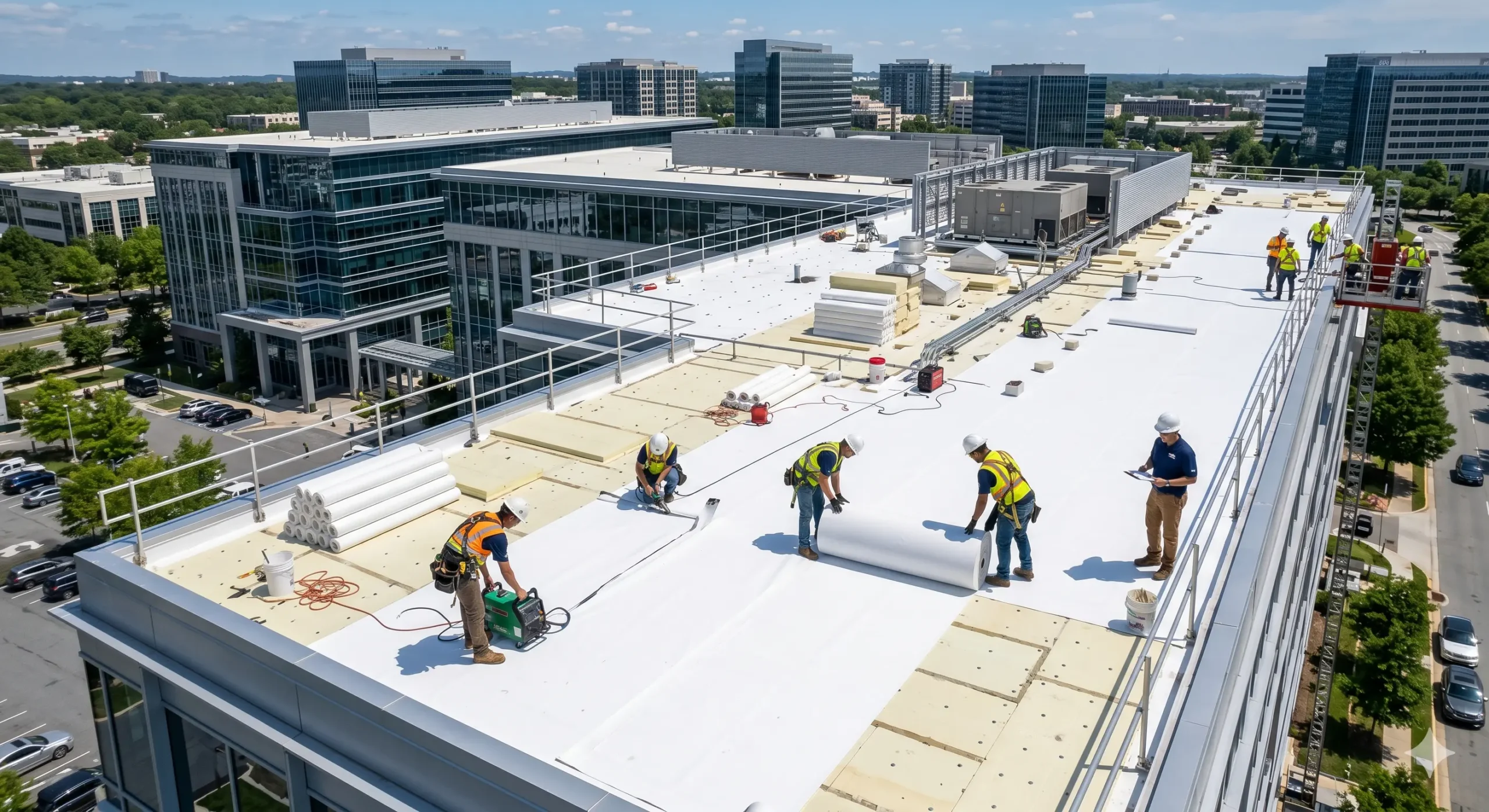
SummitShield Roofing provides commercial roofing in Falls Church, VA for property owners, businesses and property managers who need the roof evaluated, the scope defined clearly and the work coordinated around the building below it.
We handle commercial roof assessment, localized repair, larger corrective roofing scopes and planned roof care based on the existing roof system and actual property conditions.
SummitShield is a Virginia Class A licensed and fully insured roofing contractor with general liability and workers’ compensation coverage, trained roofing crews and documented workmanship standards.
Commercial roofing shouldn’t be approached as residential roofing on a larger building.
The roof geometry may be different. Access can be different. Drainage may be handled through roof drains, scuppers or other systems. Mechanical equipment and penetrations may occupy large portions of the roof, and the work may need to happen while tenants or employees continue using the property.
For a commercial roofing contractor, that changes the questions that need to be answered before work starts. We want to know:
The roofing recommendation should account for both the roof and the way the property operates.
A property manager may call because water is entering one suite.
That doesn’t automatically tell us where the roofing failure is located.
Water can enter at one part of a commercial roof and travel along decking, insulation, structural components or other surfaces before it becomes visible inside.
For that reason, we don’t begin by assuming the exterior failure sits directly above the interior stain. Depending on the roofing system and complaint, relevant areas can include:
NRCA roofing education treats slope and drainage, roof decks, flashing, inspections and leak investigation as interconnected parts of roof repair and maintenance rather than separate issues. (National Roofing Contractors Association)
The first objective is to identify the condition before deciding how large the project needs to become.
Commercial roof inspection is most valuable when the result can be used to make a decision.
A report full of photographs without context isn’t enough.
Where useful, SummitShield documents significant conditions and connects them to the proposed next step. That may include:
Which roof section, penetration, drainage area or interior zone is affected?
What was actually observed?
Does the problem appear localized, repeated or widespread?
Is the condition affecting an occupied area, equipment, access point or other part of the property that changes project priority?
Does the condition support monitoring, localized repair, maintenance work or a larger roofing scope?
If your primary need is an overall condition assessment rather than a specific commercial repair, review our professional roof inspection service.
“Commercial roof” does not describe one roofing assembly.
Some commercial buildings have steep-slope sections. Others have flat or low-slope roofing, and some properties combine different roof elevations or systems.
For a flat or low-slope commercial roof, water management deserves particular attention because the roof relies on its designed drainage path to move rainfall toward drains, scuppers or other outlets.
Roof drains are typically positioned at low points, where leaves and other debris can accumulate. GAF recommends including drain inspection and maintenance in regular commercial roof inspections because restricted drains can contribute to ponding water. (GAF)
That means a commercial leak investigation should not focus only on the wet interior area. We may also need to consider:
Simply sealing the first suspicious location may not solve a problem that is being driven by drainage or another roof-system condition.
Not every commercial leak requires a major roofing project.
When the defect is localized and the surrounding roof remains serviceable, a focused repair may be the correct scope. Depending on the existing roof, that can involve conditions around:
The important question is whether new work can be integrated reliably with the existing roofing assembly.
If the surrounding roof is extensively deteriorated, repeated repairs are failing or moisture-related conditions extend beyond the visible defect, continuing to patch individual areas may stop being the best long-term decision.
We explain that distinction rather than treating every commercial repair call as either a tiny patch or an automatic replacement.
The number of leaks matters less than the pattern behind them.
One defined failure may support one defined repair. A different situation exists when:
At that point, the property owner needs a broader scope discussion rather than another isolated repair.
A larger recommendation should explain why the roof has moved beyond a localized service issue. That gives owners and managers something concrete to evaluate when making capital-planning decisions.
A commercial roofing project doesn’t happen on an empty site.
The property may remain open while the work is underway. Before a larger project begins, practical coordination can include:
Roof access, ladders, equipment and materials have to reach the work area without creating unnecessary conflicts with entrances or occupied spaces.
The project should identify areas where roofing activity could affect people entering or using the building.
The objective isn't to promise that roofing work creates no disruption.
It's to identify avoidable conflicts before the crew is already on-site.
Material staging, dumpsters where applicable, crew vehicles and work zones may interact with loading areas or parking.
Those needs should be considered during project planning.
HVAC units, vents, pipes and other rooftop equipment can affect both access and roofing details.
Work near equipment should be planned around the existing roof assembly and the responsibilities of other trades where appropriate.
When a leak affects an occupied space, access inside the property may be needed to connect exterior roofing findings with the interior symptom.
A commercial roofer should be prepared to discuss these constraints as part of the project rather than treating them as somebody else’s problem.
For a property manager, documentation can matter almost as much as the repair itself.
You may need to explain the work to an owner, tenant, asset manager or another decision-maker who wasn’t on the roof. SummitShield uses photo documentation where it helps establish:
A useful written scope should also distinguish what is included from what is outside the roofing work.
That reduces ambiguity when several people are involved in approving or managing the project.
Before approving work, a property owner or manager should be able to identify the major project assumptions.
| Scope item | What should be clear |
|---|---|
| Affected roof area | Which section of the building is involved |
| Existing condition | What roofing problem was identified |
| Proposed work | What will be repaired, corrected or replaced |
| Roof system | Existing assembly and materials relevant to the work |
| Drainage | Whether drains, scuppers or water flow affect the scope |
| Penetrations | How vents, curbs or other roof openings are handled |
| Access | How the crew will reach and stage the work |
| Occupied areas | Any coordination needed around tenants or operations |
| Documentation | Conditions or work stages that will be recorded |
| Cleanup | How the work area will be left at completion |
| Warranty | Applicable workmanship or manufacturer coverage |
A short scope is not automatically a bad scope.
A vague scope is.
Commercial roofs benefit from being managed before the only signal is water entering the building.
Routine inspection and maintenance can help identify drainage restrictions, flashing concerns, surface defects and other conditions before they become larger service calls. GAF’s commercial guidance also emphasizes routine inspections and drainage maintenance as part of proactive roof care. (GAF)
For property managers, that changes roofing from “something leaks → make an emergency call” to “inspect → document → prioritize → repair → monitor.”
The words “flat roof” don’t identify a specific roofing product.
The existing assembly, roof slope, drainage design, penetrations, rooftop use and project objective all affect which roofing solution makes sense. That matters whether the project involves a localized repair or a larger roof scope. A proposed system should be considered in relation to:
We don’t need to turn this commercial service page into a product catalog.
If system selection is the main decision, review our guide to commercial roofing materials for deeper material context.
The practical constraints around a commercial property can change how roofing work is organized.
A project may need to account for customer entrances, tenant access, sidewalks, parking, deliveries, adjacent properties or restricted staging space.
Those constraints don’t change the roofing physics.
They change how the work should be executed.
Before larger work begins, SummitShield considers both the roof scope and the areas below and around it so project logistics are defined before materials and crews arrive.
Commercial roofing is one specialized part of SummitShield’s work as a Falls Church roofing contractor.
A property manager evaluating a roofer should look for evidence relevant to commercial work. Useful project documentation can show:
A finished photograph is useful.
A before-and-during sequence is often more informative because it shows what was actually corrected underneath the finished surface.
You can see commercial roofing projects and other SummitShield work when evaluating our project approach.
For a commercial property, credentials matter because multiple people, occupied spaces and business operations can be affected by the work.
SummitShield Roofing operates as a Virginia Class A licensed and fully insured roofing contractor, with general liability and workers’ compensation coverage.
The objective isn’t to build the longest credential list. It’s to give the property owner confidence that the roof condition, work scope and project logistics will be handled professionally.
The inspection should follow the roof system and the problem being investigated.
Relevant areas can include the primary roof surface, flashing, penetrations, perimeter details, rooftop curbs, drainage points, previous repairs and interior moisture evidence. Low-slope roofs also require particular attention to drainage and areas where water may collect. (GAF)
Yes, when the failure is localized and the surrounding roof can support a reliable repair.
If leaks are recurring across unrelated areas, the existing roofing is extensively deteriorated or moisture extends well beyond the visible problem, a larger corrective scope may make more sense.
The condition should determine the project size.
SummitShield evaluates and services flat and low-slope commercial roofing based on the existing roof assembly, drainage, penetrations and condition.
Because flat and low-slope roofs are not all built with the same system, the roofing scope should be defined after identifying what is actually installed rather than assuming one membrane or repair method applies to every building.
That depends on the building and project.
Planning can account for roof access, customer and tenant entrances, parking, deliveries, rooftop equipment and areas where roofing activity could affect normal operations.
Those constraints should be discussed before larger work begins so the roof scope and site logistics are coordinated together.
Routine condition checks can be useful even when there is no active interior leak, particularly for low-slope commercial roofs where drainage, penetrations, flashing and surface conditions can change over time.
GAF’s commercial guidance emphasizes proactive inspection and drainage maintenance rather than relying only on active leaks as the trigger for roof care. (GAF)
You don’t need to identify the roofing system or diagnose the leak before speaking with us.
Tell SummitShield Roofing what type of property you’re managing, what has changed, where the issue is showing up and what operational constraints we should know about.
We’ll help determine the appropriate commercial roofing assessment and scope.
Serving Falls Church, Arlington, Fairfax, McLean, Vienna, Alexandria, and Northern Virginia.
Call Now