Impact
A falling branch can damage:
- 1shingles
- 2flashing
- 3ridge areas
- 4decking
- 5gutters
- 6other exterior components
That is a direct physical event.

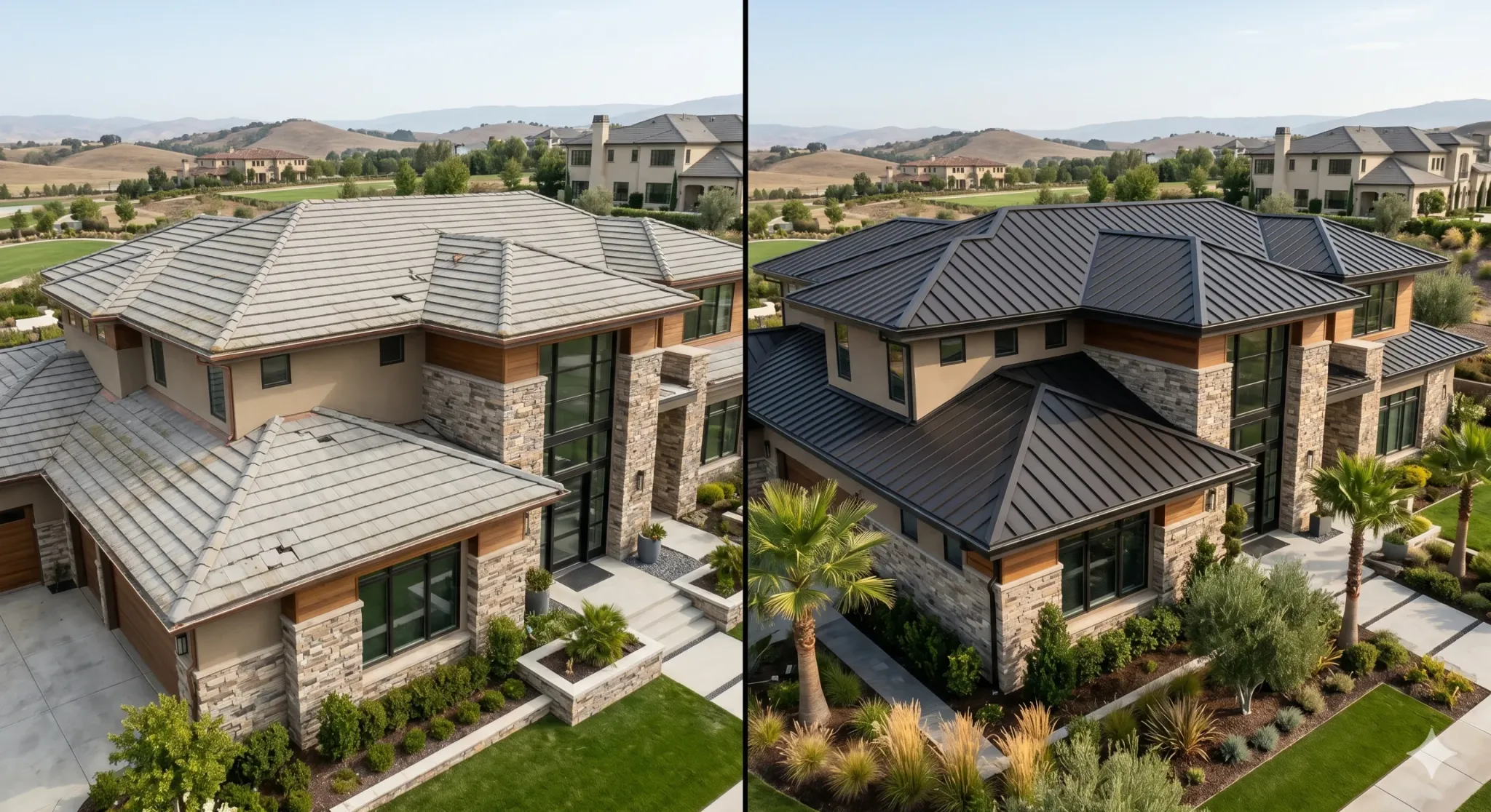
Northern Virginia roofs don’t deal with one dominant weather problem.
Each weather condition affects a roof differently.
Heavy rain tends to reveal weak water-management details. Wind can lift or remove roofing materials. Hail creates impact damage. Temperature swings can aggravate already vulnerable materials. Humidity becomes especially important inside the attic. Tree debris can create both impact and drainage problems.
The useful question is therefore not simply “Is Northern Virginia weather hard on roofs?” It is: “Which part of the roofing system is this weather condition actually testing?”
| Weather condition | What it primarily tests | What may become visible |
|---|---|---|
| Heavy or wind-driven rain | Water shedding, flashing, penetrations and drainage | Leaks, attic moisture, water around transitions |
| Strong wind | Shingle attachment, roof edges and exposed components | Missing, lifted or creased shingles |
| Hail | Impact resistance of roof covering and exposed components | Impact marks, granule displacement, damaged metal components |
| Winter freezing and thawing | Existing moisture vulnerabilities and roof-edge conditions | Recurring leaks, ice-related problems, material movement |
| Humid summer conditions | Attic moisture control and ventilation | Condensation, damp decking or elevated attic moisture |
| Leaves and tree debris | Drainage paths, valleys and gutters | Blockages, trapped debris, persistent damp areas |
| Falling branches | Localized impact resistance | Broken roofing, punctures or decking damage |
One roof can experience several of these at the same time.
A summer thunderstorm, for example, can combine strong wind, heavy rainfall, hail and tree debris in a single event.
A properly functioning roofing system is designed to shed rain.
When water appears indoors during or after rainfall, the important question is where the water-management path failed. Common areas worth professional attention can include:
Moisture from rain can exploit deteriorated shingles or flashing, and severe weather can contribute to roof leaks when roofing materials have been compromised.
Water does not always fall vertically from the entry point.
It can travel along roof decking, rafters, framing or other surfaces before becoming visible on a ceiling. That means:
water stain location ≠ guaranteed roof-entry location
A leak that appears near the middle of a room can originate higher on the roof at a penetration, wall transition or another detail.
Wind damage does not always begin with a shingle landing in the yard.
Air moving across a roof creates uplift forces that can affect roof edges and individual roofing components. A shingle may loosen, lift or crease before it disappears completely.
Current guidance identifies lifted, warped and wind-damaged shingles as potential pathways for later water intrusion.
After a strong wind event, conditions that may deserve attention include:
The roofing consequence can appear after the wind event.
The storm may compromise attachment first, while the leak doesn’t show up until a later rain.
That timing is one reason “it isn’t leaking” does not always mean “nothing happened.”
Hail affects roofing differently from wind.
Wind works primarily through uplift and movement. Hail applies impact energy to the roof covering and exposed roof components.
On asphalt shingles, suspected hail conditions can include localized impact marks, displaced granules or other surface effects. Nearby metal components such as vents or flashing may provide additional context.
The appearance must still be evaluated carefully. One irregular mark on an older shingle does not prove a hail event damaged the roof.
The pattern matters.
Winter temperature changes are sometimes described too broadly as though every freeze automatically damages a roof.
That is not how we look at it.
The bigger concern is what happens where moisture is already present or a roofing detail is already vulnerable.
Temperature fluctuations can contribute to roofing materials becoming brittle or cracking as they expand and contract.
A small open joint, deteriorated flashing detail or moisture-exposed component can therefore become more noticeable through repeated winter weather.
The practical lesson is not: cold weather destroys roofs.
It is: winter conditions can expose weaknesses that were already developing.
Ice dams are not simply frozen gutters.
They form when snow melts on a warmer part of the roof and then refreezes near a colder roof edge. Repeated melting and freezing can allow water to work back beneath shingles and eventually enter the attic or interior.
Roof temperature differences can be influenced by conditions inside the building, particularly heat movement, insulation and attic ventilation.
That is why an ice-related leak should not automatically be treated as only an exterior shingle problem.
The roof covering may be part of the issue, but the attic environment can also matter.
Some moisture problems start below the roof covering.
Warm, moisture-laden air can accumulate in an attic when ventilation is inadequate. Attic humidity and moisture buildup can contribute to mold and structural or roofing-system problems, and ventilation plays a key role in managing attic heat and moisture.
In a vented attic design, roofing performance therefore depends partly on maintaining an appropriate intake-and-exhaust path. That commonly means:
intake near the eaves or soffits → air movement through attic → exhaust near the upper roof or ridge
Ridge, intake and soffit ventilation work together to reduce attic heat and humidity and help manage ice-dam conditions.
Dark roof decking or damp attic conditions do not automatically mean rainwater passed through the shingles. Possible sources can include:
The pattern has to be interpreted before the roof is repaired.
That is one reason a professional assessment can be more useful than assuming every attic moisture mark requires exterior shingle work.
Trees affect roofing in two very different ways.
A falling branch can damage:
That is a direct physical event.
Leaves, needles and small branches can collect in roof valleys, gutters and other drainage paths.
This distinction matters because a branch strike is an impact-damage problem, while debris accumulation is primarily a drainage and moisture-management problem.
They should not automatically receive the same roofing recommendation.
A valley is where two sloping roof planes meet and channel runoff toward the eaves.
Because water from two roof areas is being concentrated into one line, valley performance matters during heavy rainfall.
Now add tree debris.
Leaves or small branches collecting in that drainage path can interfere with how freely water and debris move off the roof.
That does not mean every leaf-filled valley causes a leak.
It means valleys deserve attention because they combine concentrated runoff, multiple roof planes, roofing transitions and debris exposure.
On more complex Falls Church homes with dormers, additions and intersecting roof sections, there may be several valleys and transitions performing that job.
A home that has been expanded over time may contain roof sections with different slopes, ages, drainage directions, attic spaces and flashing details.
Weather tends to test the connections.
Heavy rainfall may expose a weak roof-to-wall transition.
Wind can affect a higher, more exposed plane differently from a protected lower section.
A lower-slope addition can manage water differently from the steep main roof.
The resulting issue may therefore be concentrated at where two systems meet, rather than across either entire roof.
That distinction can prevent a localized transition problem from being mistaken for whole-roof failure.
Northern Virginia has a year-round weather cycle rather than a single roofing season.
Spring weather can expose:
The roof may show a condition that developed during winter but becomes obvious only when sustained rain arrives.
Summer shifts more attention to:
Poor ventilation can allow heat and moisture to accumulate in the attic rather than moving through a balanced intake-and-exhaust system.
Falling leaves can accumulate in:
The weather issue is less about the leaves themselves than what happens when debris interferes with drainage during repeated rainfall.
Winter can bring:
The National Weather Service describes ice dams as a melt-and-refreeze problem capable of driving water beneath roofing and into the building.
A common shortcut is: “Northern Virginia gets storms, so buy material X.”
That is too simple.
Weather resistance matters, but roofing material still has to fit roof slope, roof design, existing assembly, building type, project budget, long-term priorities and installation requirements.
Manufacturers themselves recommend considering regional weather when choosing shingles, but climate remains one factor among several rather than an automatic material prescription.
If material selection is your actual decision, see our guide to roofing materials. This page stays focused on what local weather does to roofing rather than turning every climate condition into a product recommendation.
A roof does not reset every time a storm occurs.
Imagine a weathered roof that already has brittle shingles, an older flashing detail, previous repairs and some granule loss.
Now strong wind or hail arrives.
A professional assessment may find both a pre-existing roofing condition and new weather-related damage on the same roof.
Those conditions should not automatically be treated as identical.
That is particularly important when deciding whether the next step is monitoring, localized repair, storm-specific work or broader evaluation.
A storm can be the event that reveals a weakness without necessarily being the sole reason that weakness exists.
You do not need to diagnose the roof yourself. Use what happened and what you can safely observe.
| What happened | What you notice | Best next path |
|---|---|---|
| Strong wind or hail | Roof looks different, shingles missing or impact suspected | Storm-damage assessment |
| Heavy rain | Leak appears repeatedly from a defined area | Roof repair diagnosis |
| Storm passed | No active leak, but roof condition is uncertain | Professional roof inspection |
| Falling branch | Visible localized roof impact | Storm/impact evaluation |
| Several seasons of recurring problems | Multiple unrelated roof concerns | Broader roof assessment |
| Humid attic | Condensation or ventilation may be involved | Professional diagnosis before assuming exterior leak |
| Planning a new roofing system | Concerned about weather suitability | Roofing-material selection |
If the roof has been through significant weather but the condition is unclear, schedule a roof inspection rather than deciding from the ground that everything is fine or everything is damaged.
You do not need to walk the roof. From safe locations, useful observations include:
Timing can be useful information. Tell the roofer:
“It only leaks during wind-driven rain.” or “The stain appeared after yesterday’s storm.” or “This attic area becomes damp during colder weather but not during rain.”
Those details can narrow the diagnostic path more effectively than simply saying the roof leaks.
This guide is meant to explain the relationship between local weather and the roof.
It is not meant to turn every storm, rainfall event or hot summer into a roofing project.
You generally need the next service step when roofing material is visibly displaced, water is entering the building, a tree or branch has struck the roof, a storm created a noticeable change, moisture continues to return, or you cannot tell whether the condition is weather-related or something else.
If none of those conditions exists, there may be nothing immediate to repair.
If one does, SummitShield’s roofing services in Falls Church can route the condition to the appropriate service rather than treating every weather concern the same way.
Northern Virginia weather tests different roof functions throughout the year. Rain tests water-shedding details and drainage, strong wind tests roofing attachment, hail creates impact exposure, winter freezing can aggravate moisture-related weaknesses, and summer humidity can make attic ventilation and moisture control more important.
Rain is something a functioning roofing system is designed to manage.
When rain produces a leak, it often exposes a defect or vulnerable detail such as damaged roofing, flashing, a penetration or another water-management problem. The leak source still needs to be identified rather than assuming rainfall alone caused a sound roof to fail.
No.
Hail occurring in the area does not automatically prove a particular roof was damaged.
If your property experienced meaningful hail exposure, you notice a visible change, nearby exterior components show impact, or you simply cannot determine the roof condition safely from the ground, professional assessment may be appropriate.
Wind direction and rainfall intensity can change how water reaches roof transitions, flashing and penetrations.
A detail may remain dry during straight-down light rain but show a problem during stronger, wind-driven rainfall. That weather pattern is useful diagnostic information.
Excess attic moisture can affect roof decking when ventilation or moisture control is inadequate. Poor attic airflow can allow warm, moist air to accumulate and contribute to condensation and wood deterioration.
You don’t need to identify whether wind, rainfall, flashing, ventilation or another roofing detail caused the problem before speaking with a roofer.
Tell SummitShield Roofing what weather occurred, what changed afterward, where you’re seeing the condition and whether it happens repeatedly.
We’ll help determine whether the right next step is monitoring, repair, storm assessment or a professional roof inspection.
Serving Falls Church, Arlington, Fairfax, McLean, Vienna, Alexandria, and Northern Virginia.
Call Now